





Experience the authentic spirit of Gozo through its traditional summer festas — a celebration of faith, culture, community, and Mediterranean passion.
There is no Gozitan summer without feasts. Indeed, the summer feast, or festa, held in different towns and villages around Gozo is the peak of authentic community life: the sharing of high spirits and the creation of a vibrant atmosphere as the village celebrates its patron saint. As village squares become noisier with the festive fervour of the crowds and the jubilant marches of brass bands, lavishly decorated with flags, standards, and illuminated festoons, one cannot help but mingle with the crowd and, if not join directly, absorb the infectious energy and spectacle of the days.
The colourful village feasts are not meant to be a showcase but a genuine expression of celebration in honour of the saint the villagers venerate. The feast in the summer season, which might or might not fall on the liturgical feast day, is originally meant as a special thanks and a sign of filial devotion. Beyond the deep-rooted faith, villages developed traditions that fostered the festive spirit, and today every village offers a unique three-day window to experience Gozo’s culture at its finest.
All feasts originate in the church. The shrines become a centre of anticipation. Rich damask drapery adorns the walls. Silver candelabra, treasured ornaments, and the church’s most elaborate vestments are displayed for the occasion. Liturgical services are enhanced by sacred music, specially composed and performed by orchestra and choirs. Renowned local soloists contribute to the majestic church atmosphere.
Gozo feasts are kept alive through the dedication of various community voluntary groups, organised with the original aim of supporting the feast. One such group is the village group, responsible for the elaborate street decorations that transform village cores into theatrical displays of colour and light, while youth groups are typically in charge of celebratory gatherings and the revelry that animates the evenings. Even the brass bands were historically founded as celebratory groups around feasts.
Throughout the streets, private homes sprout their own festooned flag masts, proudly displaying colours with symbolic meanings. Towns celebrating martyred saints are typically awash in red, while Marian feasts, distinguished by shades of blue, create a visual identity immediately recognisable under Gozo’s summer sky.
The celebrations extend well beyond the church square. Every village will host a traditional village dinner, open even to visitors, often unfolding along the main streets or in the square. Tables are set beneath illuminated festoons to create a warm, authentic communal atmosphere, often accompanied by live music and entertainment.
Together, these traditions create an atmosphere that cannot be artificially replicated — a unique blend of confetti, chants, marching bands, solemn hymns, laughter, and even tongue-in-cheek jabs aimed at neighbouring villages. Gozitan festas are, above all, family festivals, where popcorn stalls, ice-cream vans, street-food vendors themselves become part of the spectacle. Even the village restaurants will often adapt their menus and rhythms to accommodate the extraordinary influx of visitors and celebrants.
Typically, the feast of St. Paul is the opening feast of the season. Celebrated in Munxar, at the end of May, one of the smallest villages on the island, this feast epitomises the spirit of a small community that comes together to celebrate one of Malta’s patron saints. The size of the community does not deter the organisers from going all out and creating a full-fledged feast. The next village to celebrate, right at the beginning of June, is the yet smaller rural village of Għasri. With a number of residents barely reaching 500, the feast of Corpus Christi still retains the vibe of a traditional feast, where unity and faith peak during the procession with the titular Statue of Christ the Eucharistic Redeemer, held on Sunday evening. Next, Gozo witnesses the feast of the Sacred Heart of Jesus in Fontana. Although another small locality at the outskirts of the town of Victoria, the community at Fontana pulls together another feast complete with church services, band marches, processions, and fireworks displays.
From intimate, smaller feasts featuring quieter village charm, Gozo moves to large-scale, vibrant festa mode in the third weekend in June, dedicated to the feast of St. John the Baptist in Xewkija. Xewkija is the oldest village on the island of Gozo and is famous for a grand feast that extends beyond the main weekend. Notorious for exuberant street celebrations, the supporters of this feast have risen to legendary status for the way they orchestrate them, roping in unique creations such as the gigantic umbrella under which the revellers dance. The feast of Saints Peter and Paul, better known locally as Mnarja, is celebrated in Nadur on the 29th of June, coinciding with the national feast day. This is another major celebration, not only because it takes place in one of Gozo’s larger towns, but also because Mnarja preserves the atmosphere of a traditional harvest and folk festival deeply rooted in Maltese cultural identity. Joining in with the locals means participating in one of the oldest feasts, as Mnarja has a distinct identity from other typical summer feasts. One distinct event is an agrarian exhibition of agriculture and craftsmanship, featuring a vibrant program of artisan displays, traditional food, and live demonstrations.
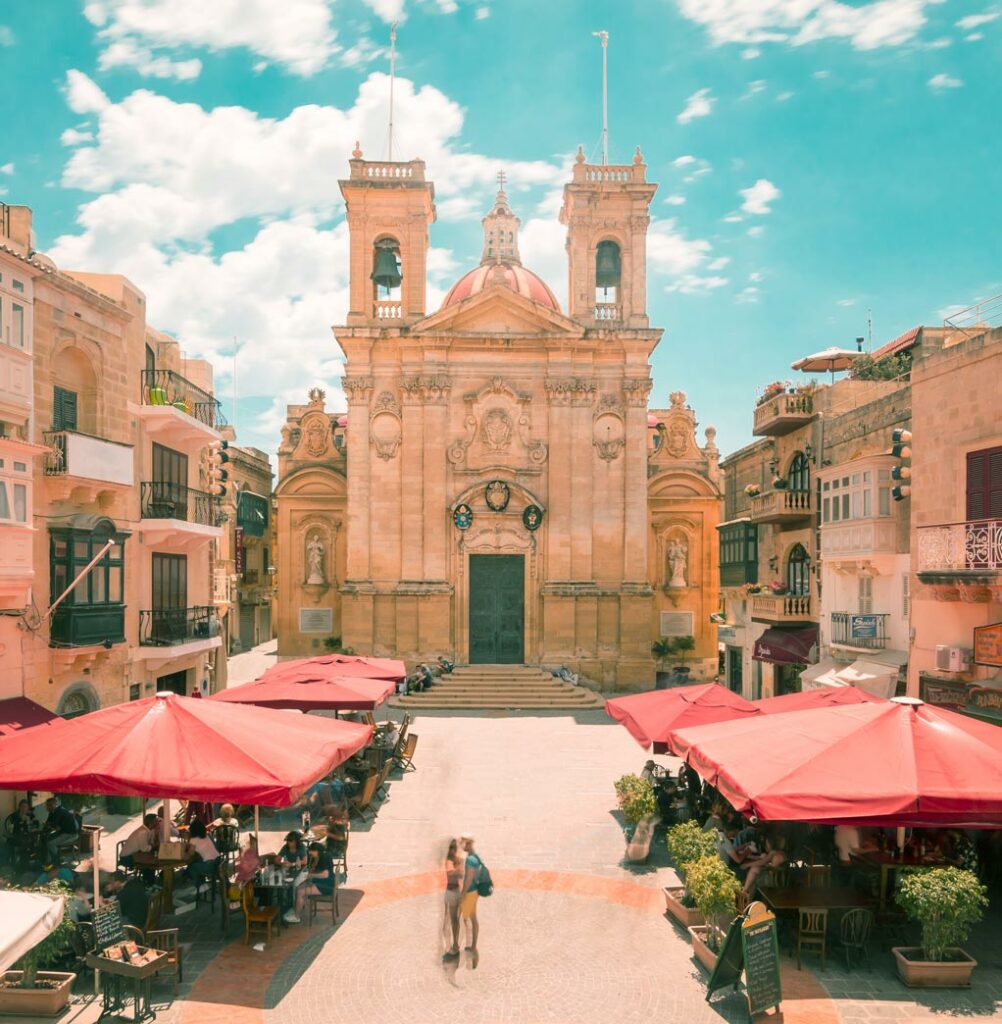
Once July is here, it’s time for the next set of feasts. The first July feast takes place in the village of Għarb. This popular village festa, celebrated by the Basilica and Collegiate Parish Church, celebrates the Visitation of Our Lady and has become highly renowned for the inforiata tradition, where a rich carpet of flower petals covers the street. Our Lady of Perpetual Help (Tas-Sokkors) in Kerċem is the next Gozitan feast. This is another quaint village feast. The village feasts are typically centred around the parish church, but in Kerċem, one particularly awaited part of the feast is the fireworks show, which takes place at the periphery of the village, staged in the freshly harvested fields. July is also synonymous with the celebration of the martyred saints Saint George and Saint Margaret. The first is one of the island’s major feasts, held in Victoria and drawing visitors even from mainland Malta. Saint Margaret’s feast is about another village swathed in red in honour of the saint’s martyrdom, and is historically renowned as a feast synonymous with spectacular pyrotechnic displays.
At the turn of August, the village of Qala celebrates its patron Saint Joseph. The next feast to be celebrated is that of St Lawrence in the village that bears the same name. The feast, which this year falls on 9th August, will also fall close to the annual Perseid meteor shower, which peaks around 11–13 August each year. Traditionally, people associated the falling meteors with the tears of the martyrdom of Saint Lawrence because the meteor shower appears around his feast day.
The rest of August is a tour of Marian feasts. Starting in Victoria, the feast of the Assumption of Mary is one of the island’s bigger feasts. Practically, all the islanders turn up in Victoria, thronging the streets of Victoria, right up to Cathedral Square. One of the most awaited moments is the fireworks display, visible from the Cathedral ramparts and the surrounding slopes. The next weekend, the village of Żebbug celebrates Our Lady again, with another beautiful village feast centred around the church, renowned for its ornate alabaster décor. The last feast in August is the one in honour of Our Lady of Loreto in Għajnsielem. This feast is a spectacle in its own right, with fans taking the celebration to another level. Over and above the typical celebrations, revellers are known to impress by everybody donning an outfit made from the same patterned textile. From little toddlers held in hands to adolescents, men and women alike are wearing the same garb. Beyond this, the village is also known for a tradition that honours the story of Our Lady of Loreto. The villagers have devised a system for making a statue, which is transported across the square, suspended on cables, to represent the story of our Lady’s house being flown to Loreto, Italy, by angels.
September is a mix of the quaint and the aplomb. The feast in the bay of Xlendi, honouring Our Lady of Mount Carmel, is typically small-scale, centred around church services, but with a procession along the seafront, where the statue pauses, as fireworks are let off from barges outside the bay, lighting up the sea and sky. The main and much-awaited feast of September is the Nativity of Our Lady, lovingly referred to as Il-Bambina, on 8th September in Xagħra. It attracts large crowds, signalling that the summer festa season is coming to an end. This feast is thickly entwined with Maltese traditions, as the 8th of September is also a national day of celebration in Malta, a reminder of when the Maltese islands, under the leadership of the Grand Master Jean de La Vallette, defeated the Ottoman Empire. The last official feast is the smaller feast celebrated in Victoria at the Capuchins’ church dedicated to our Lady of Graces. Once again, the smaller feast encapsulates the community’s spirit of celebrating and honouring the saints who have been held in special regard over the centuries.
As the Gozitan community repeats this cycle of feasts every year, there is no doubt that as it celebrates its beloved patron saints in the most passionate of Mediterranean ways, it is also celebrating itself!
Note: This year, the feast of St. Paul has been moved to 13th September.
BACK TO BLOG POSTS