








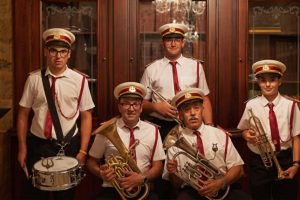
Just a week before the grand feast of Xewkija, at one of the busiest times of the year for Omar Camilleri, VisitGozo managed to find a brief moment to catch up with him. Deeply involved in the operations of the Soċjetà Filarmonika Banda Prekursur, the 45-year-old father of three proudly describes himself as a true patriot of Xewkija.
Omar is not only a musician but is also actively involved in the Band Commission, the section responsible for many logistical aspects of the society’s work. His connection to the band runs much deeper than any official role. Indeed, he can easily be described as having been born into the band. His father has been playing with the band for over fifty-five years, while his grandfather before him was equally immersed in the society, along with a string of uncles and other family members. As a little boy, Omar accompanied his father to rehearsals and band activities, clutching a toy trumpet with the same dedication as a fully-fledged bandsman. At the age of seven, he was entrusted with a real alto horn and formally joined the band. Now forty-five years old, Omar can scarcely imagine life without the band. “I don’t know what my life would be like without it,” he admits.
Today, his three sons all play with the Xewkija band, continuing a tradition that spans generations. Being born into a tradition is one thing, but embracing it is another. For Omar, the band is rooted in a genuine passion for music. He describes music as a language without boundaries, one that goes beyond nationality, social class and culture. “If English is spoken around the world, music goes even further,” he explains. “The same notes are played and understood everywhere.” Music also transcends time, and the marches that echoed through the streets generations ago still inspire the same excitement, pride and emotion today.
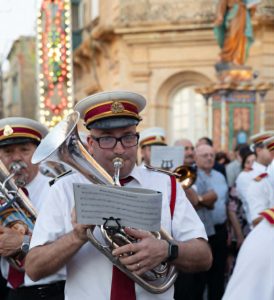
For the Soċjetà Filarmonika Banda Prekursur, all roads lead to the feast in honour of St John the Baptist, the annual June celebration that remains at the heart of its purpose and identity. As a proud Xewki and devoted admirer of St John the Baptist, Omar dedicates countless hours to the preparations surrounding the feast. He is fully aware that much of this time comes at the expense of family life. Fully aware that without volunteers no Gozitan band would manage, Omar clearly states that, for him, volunteering is also about stewardship. “My father passed this inheritance on to me, just as his father did before him. Now I have to pass it on to my children, and hopefully they will do even better.”
When Omar joined the band thirty-seven years ago, things were considerably different. The feasts on the island were smaller, and the band’s activities revolved largely around the summer feast services. Besides the village feast itself, the band would participate in other village feasts when invited, performing marches and animating the feast. Outside the feast season, activities were generally limited to the Christmas procession and the procession of Our Lady of Sorrows. Today’s cultural scene has expanded considerably, and the band’s calendar of events now includes a wider repertoire.
While visitors enjoy the joyous cacophony of colour and music of the festa, few realise the months of preparation that make it all possible. One of the band’s largest annual undertakings is preparing the feast concert. Once the musical programme is selected and the scores obtained, Omar works closely with the musical director to prepare the individual parts for each band section, often producing around 60 separate copies. The process begins as early as December. He smiles as he recalls helping his father carry out the same task decades ago. Back then, parts had to be manually collated and glued together into librettos. Today, the process is largely digital, yet some traditions remain unchanged. Just as his father once enlisted his help, Omar now turns to his own children to assist in marking repeats and preparing music for rehearsals.
Beyond the concerts, the band is committed to both innovation and preservation of musical heritage. Regularly, the band acquires new marches and also revives older works from the archives. Some of these compositions may not have been performed for decades, and Omar explains that his uncle, a retired but passionate band enthusiast, often identifies forgotten pieces worth reviving. This is a process that at times requires adapting scores for instruments such as flutes and xylophones, which were only recently added to typical Gozitan bands.
Beyond the marches, every village has compositions that are considered the anthems and hallmarks of the feast. Typically, each village has at least one religious hymn woven into its identity and another, more celebratory, anthem called Innu Marċia. For Omar, these are the melodies that tell the story of the community itself. Echoing the spirit of his upbringing in the fold of the band, he comments that even two-year-olds can recognise the tunes and sing the words. In Xewkija, the Innu l-Kbir (The Grand Hymn) is a cherished composition that continues to stir emotions generations after its first performance. “Even today, it still gets to me,” Omar confesses, and when the statue of St. John emerges on the parvis on Sunday evening to the sound of this hymn, Omar often notices many people wiping away tears.
When Omar is asked what makes a festa truly special, his answer comes quickly. While fireworks, decorations and celebrations all make up the Gozitan feast, he insists that the band remains its beating heart. “A feast without fireworks may feel empty, but a feast without a band is completely empty. It would be like having a feast without church functions.” Whether accompanying revelry through the streets or performing on stage in the village square, the band provides the soundtrack to the festa experience. As a festa enthusiast who appreciates all that goes into creating the Gozitan village festa, Omar advises that summer visitors would be missing out terribly if their holiday did not include the weekend experience of the village festa.
Now that Soċjetà Filarmonika Banda Prekursur approaches its centenary in 2029, Omar explains that local brass bands emerged from the English military band tradition and fused with village feast celebrations. The humble beginnings of a handful of musicians laid the foundation for today’s musical societies, whose roles extend beyond musical performance. In fact, Omar believes that bands are among the most important custodians of the Gozitan feast, preserving traditions, music and customs. “Without the band, a feast would simply be a street party,” he remarks. “The band gives it meaning, atmosphere and tradition.”
What continues to encourage him most is seeing the enthusiasm of younger generations. Despite changing lifestyles and modern distractions, young people continue to join the band, participate in activities and contribute to the organisation of the feast. One key facet of the band is the provision of free tuition in theory, percussion, and wind instruments through four resident maestros. Omar explains that the Youth Band Concert is one of the highlights of the year as it offers young musicians a first taste of public performance and motivates them to continue their studies until they eventually join the band’s ranks. He also explains that he witnessed the rise of Għaqda Brijużi Żgħażagħ Xewkin as a subcommittee established to organise the revelry associated with the feast, which eventually developed into an independent NGO responsible for organising events and securing funding.
However, the society’s role extends well beyond music. The club serves as a gathering place for people of all ages. Various committees organise activities throughout the year, while a very active Ladies’ Circle undertakes fundraising initiatives. Youths organise dinners, coffee mornings and social activities. Now with the feast on the doorstep, the spirit of celebration can be felt throughout the band club itself. Many volunteers prepare for the occasion in countless ways. Even the women of the club play their part, hanging damask curtains and decorating the main hall in preparation for the festivities. For Omar, these acts of dedication are every bit as important as the music itself, reflecting the collective effort that keeps the feast tradition alive.
The band club, which today occupies a prominent place in village life, is also intertwined with Omar’s own family history. His grandfather, Lawrence Camilleri, once made the family windmill in Xewkija available to the band as its premises before the society eventually acquired its present home. Like his father before him, Omar stepped forward when society needed his help. Though he has served on committees at different times, his commitment has never been about titles or positions. Rather, it stems from a sense of responsibility towards a legacy handed down through generations.
Perhaps no moment captures this better than the day the band performed his first composition over 20 years ago. It marked the beginning of his contribution as a composer and was the first of many marches he would go on to write for the society. This year, however, brought an equally special moment as his teenage son composed his first march, which the Xewkija Band will play during this year’s feast. For Omar, this moment encapsulates far more than musical achievement. It is proof that the chain remains unbroken and that the tradition he inherited is being passed on to the younger generation.
For Omar, the band is not simply part of life. It is life itself, and as long as new generations continue to answer its call, the band will indeed play on.
VisitGozo would like to thank Mr Omar Camilleri for this interview and for kindly sharing the photographs.
BACK TO BLOG POSTS