







Visiting Gozo is about discovering stories, some as old as time. Wandering around the island will, no doubt, lead you to some of the most interesting and intriguing historic places, but being organised in your quest for historic gems will make sure you do not miss out on any of Gozo’s historic treasures.
Visiting Gozo is about discovering stories, some as old as time. Wandering around the island will, no doubt, lead you to some of the most interesting and intriguing historic places, but being organised in your quest for historic gems will make sure you do not miss out on any of Gozo’s historic treasures.
Where Gozo’s story began
Gozo’s story begins thousands of years before the written records. Indeed, the island’s prehistoric past remains shrouded in mystery that over the years has become infused with myth. The temples of Ġgantija, monumental architecture dating back over 5,000 years and part of the UNESCO World Heritage sites, are typically visited by anyone who sets foot on the island. But beyond these temples, Gozo is home to other prehistoric structures, such as the Xagħra Circle, the remains of other temples on Ta’ Ċenċ Plateau, a Bronze Age settlement on Nuffara Hill, and a series of menhirs and dolmens found in a variety of places.
Even the cart ruts etched in the rocky plateaus of Dwejra, Ta’ Ċenċ and Qala have baffled historians and visitors alike. The thought that, long before medieval villages, churches, and fortresses, Gozo was already home to a community of people skilled in building extraordinary structures is not only fascinating but also engaging for anyone who loves history.
Where the island stood on guard
Fast forward to medieval times, and Gozo had to defend itself. The island’s rural communities often faced attacks by corsairs and pirates who scoured the Mediterranean, plundering everything and everyone in sight! The villagers were vulnerable to attacks and at risk of being taken as slaves and sold on the slave market in North Africa and Constantinople. The Citadel in Victoria, the heart of fortified Gozo, with its layers of history that can be peeled back to prehistoric times, was the haven where villagers rushed when the marauders’ alarm was raised. Together with their families and livestock, they ran up the steep hill and locked themselves inside the Citadel.
However, Gozo’s defence system was not limited to the Citadel. It eventually encompassed a series of watchtowers around its coast, built as a defensive network. The Dwejra Tower, the Mġarr ix-Xini Tower, the Sopu Tower, and the Xlendi Tower still stand around the island, along with some batteries and even the grand Fort Chambray, overlooking Mġarr Harbour.
In the last century, standing guard took on a new meaning as Gozo defended itself against World War II air raids. Today, you can still visit locations such as underground shelters, the underground flour mill in Xlendi, and Ġurdan Hill, which was not only a vantage point but also housed the radar unit for the famous operation ‘Husky’.
Today, touring these places is about absorbing the tranquillity and spectacular views, but that was not always the case. In times gone by, these vantage points served as the defensive frontier, signalling the approach of enemies.
Where faith became architecture
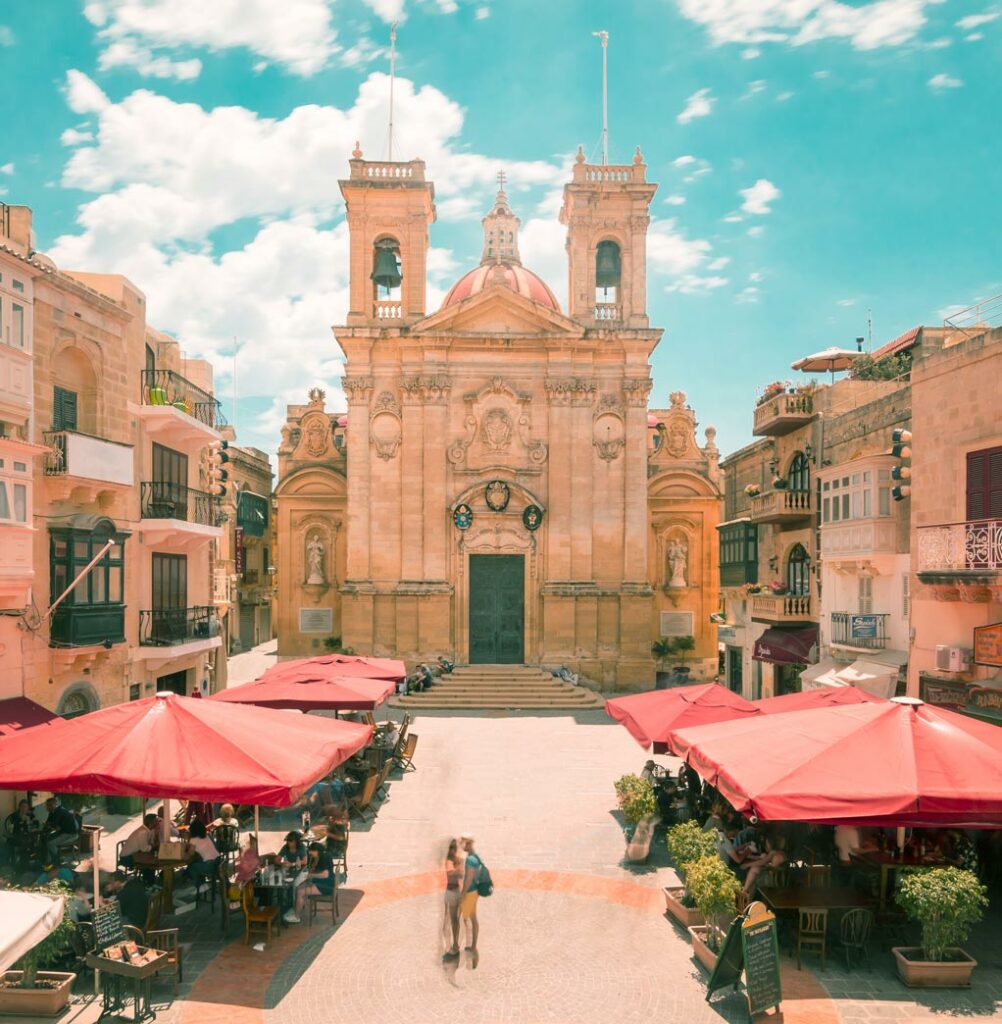
Gozo is the place where faith has become architecture. The religious heritage of the island is visible not only in its grand churches and basilicas, such as the Basilica of Ta’ Pinu, known as a national pilgrimage destination, the baroque St. George’s Basilica, the Gozo Cathedral at the Citadel and the impressive Xewkija Rotunda.
Faith across the centuries can be seen in the older chapels scattered in the countryside and in the many niches. Each church reflects the story of the community that built it, along with its wealth, craftsmanship, and identity, culminating in the patron saint. On the other hand, visiting the rural chapels is like diving back in time. You can feel that sense of stepping back in time at Lunzjata Chapel, San Dimitri Chapel, and St. Cecilia’s Chapel, the oldest medieval chapel on the island.
Gozo’s religious heritage also shows up as you stroll along the older village streets and notice house names that acknowledge patron saints, with some even invoking a blessing with typical names such as ‘Gratia Plena’. Some of the villages still have the Dejma Cross prominently erected in the main square. Way back in time, the Dejma was a local militia that would gather at the locations of the Dejma Crosses before proceeding with their defence operations.
Beyond the architecture, Gozo’s sacred heritage continues to unfold with every passing season through feasts, processions, and pilgrimages that carry on traditions that have shaped communities for generations. In Gozo, history is not confined to museums. It is lived through many things – from the pealing of church bells and embroidered church vestments to the processional attire worn by statue bearers, centuries-old statues carried in procession, and the silver treasures found in its churches.
Where tradition shaped the landscape
When exploring Gozo, it is impossible to miss the heritage embedded in the landscape. Beyond the visible monuments, Gozo has a unique way of displaying the island’s traditional way of life. The Xwejni salt pans, carved into the low-lying rocky areas, tell the story of salt harvesting, a cottage industry still alive today.
Vernacular architecture is evident in the older farmhouses. Distinctive rural architectural features such as central courtyards, stone staircases, and beamed rooms that today host guests were once homes for farming families and their livestock. Even the rubble walls and the terraced fields that arise like patchwork over the Gozitan hills and valleys are part of the farmer’s response to Gozo’s topography and the need to create parcels of land that can grow crops. Similarly, carob trees, prickly pear, and citrus trees have been grown around field perimeters to serve as windbreaks. Vernacular architecture cannot be missed in the series of windmills https://visitgozo.com/itineraries/weve-counted-13-windmills-across-the-gozitan-landscape-do-you-know-of-more/, foremost among them are the Xewkija and Xagħra windmills that were used as flour mills in past centuries.
Beyond these, the aqueducts on the way to Ta’ Pinu, the wash house in Fontana and the Pumping Station in Mġarr ix-Xini valley are all historic buildings that speak volumes about life in Gozo in times gone by.
Where history meets myth
Gozo is also a place where myth and legend have thrived alongside history. The saga of Odysseus and his seven-year sojourn with the nymph Calypso has traditionally connected Gozo with Homer’s Odyssey. Calypso’s Cave, overlooking the spellbinding views of Ramla’s red sandy beach, is the perfect stage for this story, set on Ogygia, the island paradise identified with Gozo. Beyond this ancient epic, Gozo is also the setting for several rural and folklore legends, sometimes involving saints and miracles. In Gozo, even the place names have a story to tell.
While Gozo’s history is clearly marked in guidebooks, its real heritage is still alive. The village core, the traditional festas, the traditional music and band clubs, Gozitan food and dishes, artisan crafts like weaving and lace-making, carnival traditions, old bakeries, and trade workshops still hum with echoes of the past. In this sense, a holiday in Gozo is not only about discovering the past but living part of it, as if you could go back in time.
BACK TO BLOG POSTS