




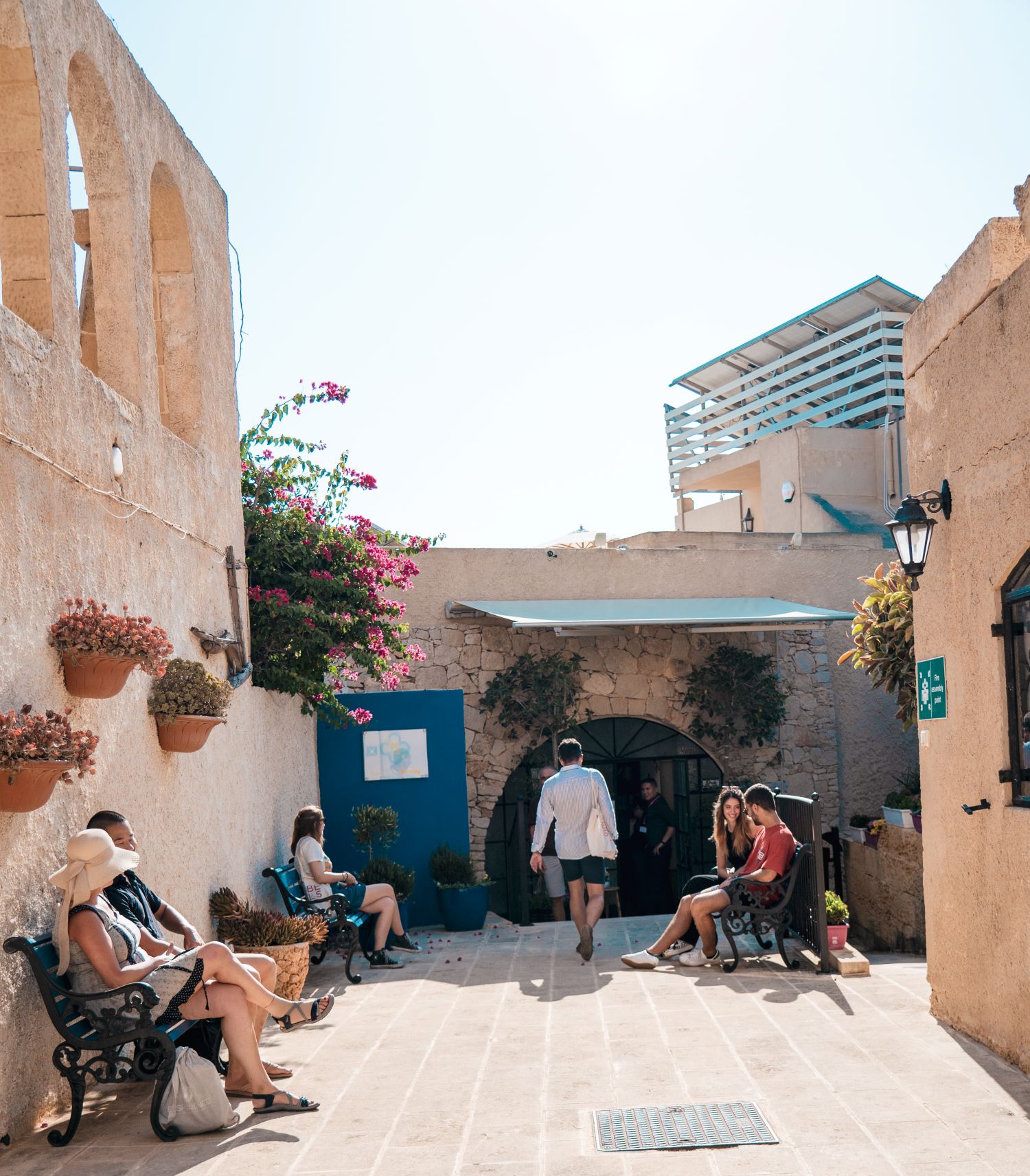




Katrin discovered the world of pottery around forty years ago, while living in the United States. What began as a hobby soon developed into something much deeper. Working as a nurse at the time, Katrin realised that pottery was her true calling – a passion she felt compelled to explore and nurture. Today, standing in her Gozo Pottery Barn at Ta’ Dbieġi Village, surrounded by the many artefacts all shaped by her hands, it is clear that her early fascination has evolved into a way of life. Having moved on from nursing, Katrin has devoted herself to the world of clay, where shape, form, texture, and colour fuse in endless possibilities.
Indeed, upon returning to the island of Gozo, Katrin opened her studio at Ta’ Dbieġi Crafts Village. She has never looked back, giving her all to the craft while continuing to seek new knowledge and skills to this day. Katrin speaks candidly about the challenges of turning a hobby into a business in the 1980s. From acquiring equipment to building a client base that appreciated her work, nothing was easy, but Katrin persevered to find her place in the market and artisan circles. Today, with several exhibitions behind her and a strong reputation as a ceramicist, Katrin’s artefacts are sought after even in the international market, and her workshops run throughout the year. Her eyes glisten as she exclaims, ‘I feel blessed that this journey was worth the while’.
Over the years, The Pottery Barn became more than a studio. Katrin explains that her family grew around this workshop. Her daughter Lisa, like her siblings, grew up in the workshop and has since become a mosaic artist herself. Today, Katrin’s grandchildren also spend time at workshop. Katrin fondly reminisces that even clients who return after many years remember these family moments and enquire about her ‘little’ children.
Katrin is keen to describe her day as a potter, even though it is not always straightforward or predictable! For Katrin, her day, in her own words, starts at night-time, when she ‘dreams’ about her work. The designs she sees in her dreams evolve into ideas, and she typically starts working on them later in the day when she gets to her workshop. Once her daily errands and teaching commitments are over, Katrin heads back to the studio, where she assesses what needs to be done. The Gozo Pottery Barn is like a varied factory line, with pieces awaiting firing, others needing glazing, and some waiting for their moment to be coloured. Although she plans her work, her artistic mood often ends up dictating the vibe for the day, ultimately deciding what gets done. Designing is half the work of a potter, and for Katrin, this is a night-time ritual that seems to happen subconsciously.
Creating a piece of pottery is an intriguing yet simple exercise. You can take a lump of clay and form it into the desired shape. If the item is larger, like a vase, the work is done in stages, building it up level by level and allowing it to dry in between. As one piece dries, Katrin typically picks up another item to work on, moving on to colouring, firing or glazing as needed. Glazing is the final step, which produces the shiny surface of ceramics.
Firing is a critical part of the process, and Katrin explains that the first firing requires the kiln to reach 900 degrees Celsius. This process spans two days, as the kiln then needs two more days to cool to room temperature before it can be opened. The second firing, after glazing, reaches 1,200 degrees Celsius. To sum it all up, an item will take at least three weeks to finish.
During summer, children’s pottery sessions take place weekly at the Gozo Pottery Barn. Courses span several lessons, giving children the opportunity to use the pottery wheels and even create their own mugs and other small knick-knacks. The flow of people through her workshop and her demonstrations bring pottery to life for many visitors, while others take part in workshops, typically booked in advance. During these workshops, participants learn the ceramic process and may start with a simple pinch pot before choosing what they want to create. Katrin guides them through the process and uses her gallery to inspire their designs. Some participants return on subsequent days to paint their work, while others opt for shorter, one-day experiences. Participants cannot leave the workshop with their creations, as each piece must first be fired. Katrin therefore offers a service whereby she completes the pieces, glazes them and ships them to clients within approximately three weeks. The Gozo Pottery Barn also hosts birthday celebrations, team-building activities and sessions for fellow artists who may be new to pottery.
As she deftly explains her work, Katrin mentions that pottery is physically demanding. Kneading clay, lifting heavy objects, loading and emptying the kiln, and preparing colours all require strength and stamina. She smiles and casually remarks, ‘This is why I don’t need the gym!’ But beyond the joking, Katrin’s voice carries a quiet love and gratitude for the world of pottery. Despite being ‘hard’ work, requiring considerable manual strength, her eyes twinkle with the knowledge of someone who loves every facet of her craft. She even describes her attachment to certain pieces and how it becomes difficult to part with them. Eventually she finds solace and joy in the birth of a new project that soon draws her back into the creative process. The Gozo Pottery Barn is far from being just a place of tinkering. It is where Katrin belongs, and she cannot imagine spending her days anywhere else.
There’s a certain cheer in her voice when she explains that the clay’s texture can be expressed in any form one wishes. Inspired by island life, encapsulated in nature, the sea and history, Katrin’s interests extend to incorporating historical elements into contemporary ceramic pieces. This process balances artistic skill with the technical expertise of a seasoned ceramicist. Yet, she also explains that clay has a character of its own and an element of unpredictability. Even after careful preparation, the kiln can produce unexpected results!
Pottery is an integral part of Gozo’s cultural heritage, dating back millennia. The importance of local artisans in keeping this tradition alive cannot be overstated because, in Katrin’s words, everything is linked, from the past to the future. Ceramic objects provide a tangible link to the people who came before us. To this, one must add the paradox of pottery: a ceramic object may be fragile and break, yet its fragments survive.
The Gozo Pottery Barn is a true hub of artistry, production, education, exhibition and even human connection. Katrin works with her hands, but meeting her, talking to her and watching her work is like hearing the hum of a song. As she aptly puts it: “The world was made for us potters. All you need are the four elements – earth, clay, air, water and fire.” Perhaps this is indeed the call of clay, a call as old as time itself.
VisitGozo would like to thank Katrin Formosa, of Gozo Pottery Barn for sharing her story and photographs for this feature.
BACK TO BLOG POSTS